Thursday, October 30, 2014

They Called Themselves the K.K.K.: The Birth of an American Terrorist Group by Susan Campbell Bartoletti


1. BIBLIOGRAPHY
Bartoletti, Susan Campbell.  2010.  They Called Themselves the K.K.K.: The Birth of an American Terrorist Group.  Houghton Mifflin.  ISBN: 9780618440337.

2. PLOT SUMMARY
Bartoletti presents historical events that brought men into the south to create a club called the K.K.K. Since the south was devastated by the civil war, men that were supposed to become heroes became powerless. It was obvious that it is wrong to have slaves in America and so a dilemma of slavery had surfaced between the North and South. After the war was over and the south was defeated 6 confederate officers: John Lester, Clavin Jones, Richard Reed, James Crowe, Frank McCord, and John Kennedy started the club. Disillusioned by the devastation and the humiliation the north had bestowed upon the south the 6 confederate men began a “Reconstruction” of the south and all the black people wondering in the south.

3. CRITICAL ANALYSIS
Bartoletti creates a realistic and well developed series of events. She takes us through a chronological order and organizes it wonderfully. Bartoletti brings forward the atrocities the freedmen endured and give plenty of facts of the times.  She documents the fears the freedmen went through when they thought they would be beaten or even killed. She backs up her primary sources with court records,  government interviews and census records. She has a unique way of placing a quote next to each picture from an interview. She has a civil rights timeline that begins with the Emancipation Proclamation and ends with the election of President Obama. In the back of her book she gives a short biography of important people as well as object and places to include the Emancipation Proclamation and the Black Codes. She has topics for discussion which can be implemented within a class discussion and stimulate emotions. Access features are evident throughout the book. A wonderful to have in any library.

4. REVIEW EXCERPT(S)
School Library Journal:   “Bartoletti effectively targets teens with her engaging and informative account that presents a well-structured inside look at the KKK, societal forces that spawn hate/terrorist groups, and the research process.”

Booklist: Starred Review – “It’s the numerous first-person quotes, though, that give the book its beating heart, and her searing, expertly selected stories of people on all sides of the violent conflicts will give readers a larger understanding of the conditions that incubated the Klan’s terrorism; how profoundly the freed people and their sympathizers
suffered; and how the legacy of that fear, racism, and brutality runs through our own time.”

Kirkus: Starred Review – An exemplar of history writing and a must for libraries and classrooms.”

5. CONNECTIONS
* Read multicultural non-fiction books
* Write a reflection about why racism is wrong
* Write a mock letter to any of the 6 confederate soldiers and tell them what they are doing is wrong.
* Create a timeline of the events in the book to show what it looks like. 

Wednesday, October 22, 2014

RODZINA by Karen Cushman


1.  BIBLIOGRAPHYCushion, Karen 2003. RODZINA. New York, NY: Clarion Books. ISBN 0-618-13351-8

2.  PLOT SUMMARY
Rodzina is about a burly, bitter Polish-American girl. After the death of her parents she is sent west from Chicago and is forced to board the Orphan Trains. The setting takes place in Chicago and ends in California in 1881. This story is told in the first person and therefore makes it believable. Rodzina is twelve-years old but looks older and therefore fears that no one will want her as a daughter but as a servant. One can only feel empathy for Rodzina when she fears she may become someones servant. Rodzina is one of twenty-two orphaned children on the train to California. One of the characters on the train is Lacey, a pretty little orphan girl who attaches herself to Rodzina.  Rodzina is well rooted in her Polish heritage which keeps her strong in her faith. She encounters conflicts when she is placed with different families. Rodzina runs away from each family until she encounters “Miss Doctor” from Mr. Bumble the School of Orphan Care who Rodzina sees as a physician and is the protector of the group. Miss Doctor comes across and cold and uncaring. However,  Miss Doctor sees through Rodzina’s tough exterior and enlists her to help care for the orphans. This open-ended book is a gem to read to students.


3.  CRITICAL ANALYSIS
 Written  mostly for upper level elementary and middle school students the author does a great job relating beliefs, values to and attitudes of characters to to the present. One can only imagine the feeling of abandonment and loneliness for the children. Cushman was successful in capturing Rodzina’s voice from the first-person aspect. The dialogue throughout the book is easy to understand. I can’t wait to read Karen Cushman’s other books!
An important theme is that anyone can overcome obstacles even if you are a child.
I like that Cushman shares stories of the others on the train and not just Rodzina. She builds a sense of authenticity with her word choices. A joy to read!
The authenticity is in the author’s notes. Cushman provides additional information on the origin of orphanages, orphan trains, and a bibliography of selected resources for students to read or view. She also included Polish culture and customs throughout the story. A glossary of Polish words and pronunciations is also provided. Cushman’s background in museum work gives her novels authenticity of the feel in the 1880s.


4.  REVIEW EXCERPT(S) AND AWARDS:


*SCHOOL LIBRARY JOURNAL: “The first-person narrative captures the personality and spirit of  
  a child grieving for her lost family, yet resourceful and determined to make her own way.

*Best Children’s Books of the Year, 2004;

*Bank Street College of Education The Children’s Literature Choice List, 2004

*Editors’ Choice: Books for Youth, 2003; American Library Association-Booklist

*Top 10 Historical Fiction for Youth, 2003;American Library Association-Booklist

*Society of School Librarians International Book Awards, 2003


5.  CONNECTIONS
*Create a plan on “How to overcome an Obstacle” using different scenarios.

*Help children understand empathy by creating a “ What would you do...?”

*Continue reading and research about the Orphan trains and how it affected children.

*Become pen pals to children from other countries

Monday, October 13, 2014

TURTLE IN PARADISE by Jennifer Holm


1. BIBLIOGRAPHY
Holm, Jennifer L. 2010. TURTLE IN PARADISE. New York: Random House.  ISBN:  0375836888

2.  PLOT SUMMARY
The setting takes place in 1935 in The Great Depression era. Eleven year old Turtle is sent to live with her Aunt Minnie after her mother takes a job as a live-in housekeeper and the mother's new employer will not allow children or her cat, Smokey, to live in the home where her mother will work. In Florida Turtle has to share a house with several male cousins who call themselves, “The Diaper Gang”  because they take care of babies in exchange for treats or money. Turtle realizes how different Key West is and how people are different than what she is accustomed to. Surprisingly Turtle meets her grandmother after she was told she was dead. While at her grandmother's house Turtle finds a treasure map and endeavors with her cousins to find the treasure. Turtle is portrayed as a tough girl who takes on adventures with her cousins especially the mystery that surrounds Nana Philly and finding the treasure.  In the end Turtle realizes that the people that love her are her family and that life is not always as it seems.

3. CRITICAL ANALYSIS
The book is narrated by the main character, Turtle. Holm gives a inspired account of her grandparents who lived in Key West during the depression. Since it is told in first person it gives an insight about the life of an eleven-year old. The theme of this book is about family unity. Even though it takes place during the Great Depression and money is scarce children in this story are not affected as it does in adults. It could be because of the close knit community in Key West. Children need to enjoy their childhood despite the circumstances and Holm made sure of that. The foods stated in the story were the authentic foods available in Key West at the time. Holm included them so that the reader can have a sense of reality. Can’t wait to read this book to my students and give them a sense of appreciation for their family!
An author’s note is included in the back of the book as well as photographs to show its authenticity. Several resources and websites are included so that the reader can research.


4. REVIEW EXCERPT(S) AND AWARDS
*Newberry Honor

*Golden Kite award or Honor Award

*ALA-ALSC Childrens Notable Book

"Holm uses family stories as the basis for this tale, part romp, part steely-eyed look at the Depression era. "  Booklist starred (April 15, 2010 (Vol. 106, No. 16))

"It's 1935, and narrator Turtle is sent to live in Key West. With her stoic nature and quick wits, she's able to fit in with her boy cousins. Turtle's voice is tart and world-weary. Though her narrative is peppered with references from the time, modern-day readers will have no trouble relating, and the fast-moving plot will keep them interested to the end. Reading list, websites."  Horn Book starred (Fall 2010)


5. CONNECTIONS
*Show a preview video of The Great Depression from brain pop before reading book to activate any
   prior knowledge they may have:
   http://www.brainpop.com/socialstudies/ushistory/greatdepression/preview.weml

*Create a KWL chart about The Great Depression
*Pair students to read other books about this era:
    Macaroni Boy by Katherine Ayres (For Boys)
    The Miner’s Daughter by Gretchen Moran Laskas (For Girls)

Wednesday, October 1, 2014

ONE CRAZY SUMMER by Rita Williams-Garcia


1. BIBLIOGRAPHY
Williams-Garcia, Rita. 2010. ONE CRAZY SUMMER. Narrated by Sisi Aisha Johnson. ISBN 9781449821968

2.  PLOT SUMMARY
Delphine is an eleven year old who is sent  by their father with her younger sister’s Fern and Vonetta to spend the summer with their mother(Cecile) who had abandoned them years earlier.
It is the summer of 68’ in Oakland when African-Americans were facing discrimination and the Black Panthers formulated to serve the needs of the oppressed people.
When they arrive to visit their mother she makes it clear that she wants nothing to do with her children and basically allows them to fend for themselves. Cecile sends her daughters who are a nuisance to her to a summer camp run by the Black Panthers. Delphine begins to understand what the Black Panthers represent and even take part in the rallies. Delphine realizes that her mother is a poet with the Black Panthers and is known as Sister Nzilla. All through the story Delphine and her sisters want the love of their mother and it seems they almost get it when Delphine reads something her mother wrote. However,  Delphine comes to the conclusion that she is on her own but her experiences change her in a way she did not expect.

3. CRITICAL ANALYSIS

Williams-Garcia educates the reader of some of the charitable programs they set up. She portrays the Black Panther’s in a positive light. Delphine who is the oldest has a burden of being a mother to her two sisters. When reading the book one can only sympathize for Delphine. Williams-Garcia makes you believe that these characters are real people. This story is about overcoming , prejudice, self acceptance and forgiveness. The theme of this book is about family and close bondness. The center of this family bond is their grandma. She grounds them through her religion. While reading this novel the reader can see that actual characters in the mind as she makes them real. While it is a historical fiction I can only contemplate how difficult it was for a child to grow up in times when racial discrimination was prevalent in our society and have to feel the weight of the world on their shoulders.  The use of the word “Negro” in this story is a word that is not accepted in today’s society. I feel the author pushed the limits and we must be cautious about how we address people. We need to learn from the past mistakes as part of history. On the back of the book Williams-Garcia acknowledges the articles, books as well as interviews that helped her write the book. She also makes reference to the Black Panthers help in her book. What a great book to read in February’s Black history month. This book will make children appreciate their roots and show an appreciation for their loved ones.


4. REVIEW EXCERPT(S) AND AWARDS:

Review from PUBLISHERS WEEKLY: “Delphine's growing awareness of injustice on a personal and universal level is smoothly woven into the story in poetic language that will stimulate and move readers.”
Starred review from BOOKLIST: “Set during a pivotal moment in African American history, this vibrant novel shows the subtle ways that political movements affect personal lives; but just as memorable is the finely drawn, universal story of children reclaiming a reluctant parent's love.”

KIRKUS review: “The depiction of the time is well done, and while the girls are caught up in the difficulties of adults, their resilience is celebrated and energetically told with writing that snaps off the page.”

*The Coretta Scott King Award and the Newberry Honor Book.
*Scott O’Dell Historical Fiction Award Winner
*School Library Journal Best Books of the Year
*Newbery Medal Honor Book


5. CONNECTIONS

 *Complete a character analysis on Delphine and see how she changes from the beginning of the
   book to the end.

*Read books about civil rights movement and write a reflection on”What would you do if you...?”

*Read the poems, WHAT HAPPENED TO A DREAM DEFERRED?, DREAMS, and
  CHILDREN’S  RHYMES by Langston Hughes. What would Cecile think of these poems? How
  about Delphine?

* Ask questions about who they can most relate to? Why?
   Delphine, Vonetta and Fern

Monday, September 1, 2014

THE GRAVEYARD BOOK by Neil Gaiman


BIBLIOGRAPHY
Gaiman, Neil. The Graveyard Book. Illus. Dave McKean. New York: Harper Collins, 2008.ISBN 0060530928.

 PLOT SUMMARY
 This is a fantastic story about a family that is murdered  by a man named Jack. The family’s toddler escapes to the graveyard where ghosts argue if they can raise a baby. He is then adopted by a dead couple, Mr. And Mrs. Owens. He is named  "Bod" (short for Nobody) because of nobody knowing his name. His ghost parents tell him that if he leaves the grave yard they cannot protect him. His adventures take him in and out of the graveyard but grows up within the graveyard as he learns to read, write and how to behave. This is a story about Good vs. Evil. We see ghosts as the good guys where they typically have a reputation of bad behavior. On the other hand the bad guys are Jack and Maureen Quilling who in this case are the bad guys. A great twist to a conventional story of ghosts, ghouls and werewolves. It makes me think if Maureen is just mean and not evil!? Even though most of the ghosts are identified, Silas(Bod's guardian) has a mystery and secrecy that children love and can possibly relate to. Silas isn't dead or alive. While thinking of Silas I can’t help but recall the book ,” Interview with a Vampire”. When it is revealed through hints such as:”Something huge was flying through the air […] something bigger and darker than the biggest bird. Something man-size that flickered and fluttered as it moved, like the strobing flight of a bat.” (6.268) that he is a vampire. Great clues for children to guess as it is an attention grabber. One theme of this novel that can help children relate to is about working and studying hard for all the necessities of life. As this story progresses Bod grows and loses his freedom of the graveyard with big dreams.  The ending of this great novel leaves you wanting more.

CRITICAL ANALYSIS
Gaiman’s descriptive and imaginative world was wonderful. It encompasses a world of mystery and creepiness. Kids will love this novel as they get lost in a world of wonderful characters in incredible adventures with lots of mystery. The language is very simple to understand and yet could be scary for the young reader. Through the illustrations Gaiman paints a picture in my mind. There are several  themes established in this story. One is about community, "It takes a village to raise a child" and indeed we have a graveyard raising Bod and they learn about compassion and forgiveness through raising him. It makes me think if it is possible to forgive someone who has murdered your family and wants to murder you? These are issues that can be discussed in a book talk session with children( Out of the mouth of babes). After reading this book it shows that graveyards don’t always hide evil ghosts but friendly ones. This novel is also available in audio book.

AWARDS and  REVIEW EXCERPT(S)
* 2009 Newberry Medal and the 2009 Hugo Award.

*2009 Locus Poll Award

*2010 Carnegie Medal
“Gaiman writes with charm and humor, and again he has a real winner.”
— Voice of Youth Advocates (VOYA) (Starred Review)

* “The Graveyard Book confirms what I’ve always thought: Neil Gaiman is a literary genius!”
— James Herbert, author of The Secret of Crickley Hall

CONNECTIONS
*Book talking about their favorite part of the story.

*Discussion about forgiveness and “what would you do...?”

*Write a sequel with a buddy and display.

Monday, August 11, 2014

THE ODYSSEY by Gareth Hinds


BIBLIOGRAPHY
Hinds, Gareth. 2010. THE ODYSSEY. Based on Homer's epic poem. Massachusetts: Candlewick Press. ISBN 978076364268

SUMMARY
Hinds brings to life this young adult novel of Homer’s original epic poem. Odyssey, wants to return home to Ithaca after battling the Trojan War and into the arms of his wife, Penelope from his triumphs of the Trojan war cannot because he has angered the gods of the sea. Poseidon, god of the sea blows Odyssey off course for many years into the violent storms of the sea. Odyssey then battles sea creatures, monsters, supernatural sirens and sorceresses only to come home and fight for his throne and his beloved wife Penelope. While stranded Odysseys is unaware of those trying to take away his wife and kingdom. This is an exciting action packed story of good verses evil.

CRITICAL ANALYSIS
Hinds watercolor choices brings to life this story that is normally difficult for children to understand. His watercolors bring out the imagination of a child and leaves nothing hanging. His details are amazing and makes the reader want more. Since children are more inclined to read stories that have illustrations with bright colors they will find Gareth Hinds book hard to put down. Homer’s version is packed with action and so Hinds brings that action to life with its stunning water scenes. A child will know that this is a tale of love, bravery and adventure. Children will get lost in the plot of this story because of its dialogue which will make each page fly by quickly as it did while reading it. Cannot wait to read it to my students! I love how he gives a modern twist with words and still offers another feeling of place and time. Another very important theme in this story is of perseverance, especially in today’s life with the many demands upon children. They will be able to relate when confronted with obstacles in their lives.


AWARDS and REVIEW EXCERPT(S)
*Junior Library Guild Selection

*An American Library Association Great Graphic Novel for Teens

*Best-of 2010 lists including Booklist, Kirkus, Roger Sutton, Monica Edinger, and by many libraries.

*The Odyssey has received four starred reviews, from Booklist, The Horn Book, Kirkus, and BCCB.

*The Horn Book- A timeless long-ago past comes alive in these images of gods and heroes, monsters  and enchantresses

*Publisher's Weekly-Hinds has created a work that both honors the epic's long tradition and helps readers see these characters in a new light.

*School Library Journal-Hinds’s work will be a welcome addition for fans of Homer’s original work and for newcomers to this classic story. –Andrea Lipinski, New York Public Library.


CONNECTIONS
* Watercolor their own creatures, name them and write a short story about their own creation.

* Using web 2.0 tools create a new creature and present to class.

* Research other types of creatures such as: Loch ness monster.

Friday, August 8, 2014

THE FAULT IN OUR STARS by John Green


 BIBLIOGRAPHY
John Green, 2012  New York : Dutton Books.  ISBN-13: 9780525478812

 PLOT SUMMARY
This  contemporary realistic fiction for young adults is a beautiful yet sad novel Green has written. It is about a young girl named Hazel who is in stage IV thyroid cancer. She is sixteen years old and has obviously accepted her cancer and attends a support group for children living with cancer at the behest of her parents. Phalanxifor, the drug that has kept her alive is only an experimental drug that will have consequences for her later on. At her support group she meets Augustus, another boy who has lost a leg to cancer. They become friends and eventually romantic with each other. After sharing a book and writing to the author of “An Imperial Affliction” they decide to go to Amsterdam to meet the author. While in Amsterdam their relationship blossoms. They finally meet Peter Van Houten the author of the book they read. As it turns out Van Houten is rude to both Hazel and Augustus. It is not until towards the end of the story that it is revealed why Van Houten is so mean. Their lives are changed and the author gives an insight that because Hazel is terminal she will be the first to die, however the plot gives a twist at the end of the story and leaves even the most hardened reader crying, especially if the reader can relate to it.

CRITICAL ANALYSIS
Green does a good job with symbolism's in this novel. For example: Augustus putting cigarettes in his mouth but doesn’t light up was quite clever.  Here we have Augustus finally having power over his body and what can kill him. The essence of this is of being a love story however, Green sweetens it by bringing in “True” friendship between friends.
A theme of this story is one of mortality in that everyone no matter who they are will eventually pass on. No one is immune to diseases, not even the most innocent. When the focus of mortality is upon us we begin to find our identity. Hazel seeks her identity and finds that at the end she is happy. Green displays his writing talents and helps find a way to make things meaningful from something in life the is frightening. The characters are believable as his tone is quirky, something kids can relate to.

AWARDS and REVIEW EXCERPT(S)
 * 2006 Michael L. Printz Award

 * 2009 Edgar Award

* TIME Magazine’s #1 Fiction Book of 2012!
The Fault in Our Stars is a love story, one of the most genuine and moving ones in recent American fiction, but it’s also an existential tragedy of tremendous intelligence and courage and sadness.” —Lev Grossman, TIME Magazine

*“Green’s best and most ambitious novel to date. In its every aspect, The Fault in Our Stars is a triumph.” -Booklist, starred review

*A blend of melancholy, sweet, philosophical, and funny. Green shows us true love…and it is far more romantic than any sunset on the beach.” -New York Times Book Review

*“A pitch-perfect, elegiac comedy…it will linger long and hard in the minds of teens and former teens.” -USA Today

*“Green writes books for young adults, but his voice is so compulsively readable that it defies categorization. The Fault in Our Stars proves that the hype surrounding Green is not overblown.” -NPR 

CONNECTIONS
*Write letters to children with cancer at the same time teach literary elements that go into “How to write letters”.

*Healthy choices for the prevention of cancer.

*Students can encourage parents to donate to Candlelighter's.

Tuesday, October 29, 2013

Actual Size by Steve Jenkins


1. BIBLIOGRAPHY
Jenkins, Steve. 2004. Actual Size. Boston: Houghton Mifflin. ISBN 0547512910

2. PLOT SUMMARY
This book is geared for grade 2 but will attract children of all ages. Many animals displayed in this book give the actual size with some facts, weight and length. Many children are not fortunate to see actual sizes of several of the animals displayed in this book in a zoo. Thanks to Jenkins he shows wonderful collage illustrations and children will compare themselves in size to the animals displayed. Jenkins displays a shark’s mouth over two pages with its serrated teeth. Many children will not understand what serrated means but when shown their comprehension will build. One interesting layout that Jenkins shows is when he compares two different animals in size and weight. A way to grab the attention of children is to show a fascinating animal visual on the front cover the book . Here the author grabs the readers attention by showing  a contrasting picture of two animals on the cover page. Some animals are small for the page depicting the size such as the pigmy shrew or the dwarf goby. The author goes to extremes in sizes to show a larger than life world, its beauty and an appreciation for all living things.

3. CRITICAL ANALYSIS
When reading children’s nonfiction about animals I think about all the literary elements. This book speaks to children in the lower grades. Each page displays a life size of an animal described and at times part of the animal. Jenkins uses collage to bring out the extraordinary illustrations of each animal. Children will be absorbed in each page not only with the illustrated collages but also with the detailed information on each of the represented animals. Children at the lower grades cannot fully  picture the true size of certain animals but Jenkins illustrates many up to scale. Powerful vocabulary is important to children, here we see the word “serrated”. Just by reading that sharks have serrated teeth one does not need to explain what it means. Therefore giving children a sense of seeing the actual animal in real life. The fold out page of the crocodile and the frog give children a concrete picture of both. Graphics are very appealing to a child’s eye and will wow at each page. This non-fiction book is simple yet powerful to children of all ages.

4. AWARDS, HONORS
 
 Books of the Year Winner 2004 Ages 2 to 4 United States

 Editors' Choice Top of the List Winner 2004 Youth Nonfiction United States
 
 Orbis Pictus Award for Outstanding Nonfiction for Children Honor Book 2005 United States

5. CONNECTIONS

*Children will write about which animal they liked best in the book and illustrate it.
*Visit the library and check out books of any animal they like and write an acrostic of the animal they chose and display products.

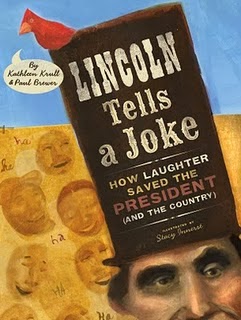
Lincoln Tells a Joke: How Laughter Saved the President (and the Country) by Kathleen Krull


1. BIBLIOGRAPHY
Krull, Kathleen, & Brewer, P. 2010. Illustrator: Stacy Innerst. Lincoln Tells a Joke: How Laughter Saved the President (and the Country). New York: Houghton Mifflin Harcourt Publishing Company. ISBN: 9780152066390.

2. PLOT SUMMARY
We always think of Abraham Lincoln as a serious president with serious issues at hand, but never as a president with a sense of humor. This complete biography shows Mr. Lincoln in a humorous light. Krull and Brewer make light of Lincoln’s life and shows how he overcame many obstacles in his life through humor. Lincoln lived in a bleak log cabin where his bed was made of corn husks and had a strict father. Because Lincoln could read and write his neighbors would hire him to write letters for them. Lincoln loved to read so much which is why his speeches were brilliant. He was a master of grammar. While in office people did not take him seriously because of his humor. The war had begun and Lincoln continued his humor. He said laughter kept him going through tough times. It is said that even in his last moments of life Lincoln was laughing. Lincoln is considered one the best presidents because he kept a nation from breaking apart.

3. CRITICAL ANALYSIS
In the last page of the book Krull has notes about her accuracy and its sources. She has a link to his famous serious words, www.lincolnbicentennial.gov/lincolns-life/words-and-speeches. “Lincoln tells a joke” is chronologically organized. Krull begins Lincolns life when he was just a little boy, he then joined the army for three months, attends school to become a lawyer, marries Mary Todd, becomes president and is assassinated.
Its design is very appealing to young readers. Illustrations show the funny side of Lincoln with his quotes in bigger text. Children need to see that quotes must be surrounded by quotation marks to stress dialogue. Illustrations are appropriate and complement the text.
Krulls style is all her own when on each page she begins the first few words of almost every page in big bold print words.This strategy helps to grab the reader in finishing the reading of each page. Again, her quotes are in cursive to give a sense of giving Lincoln a more personal approach. What I noticed is that Krull uses appropriate language for children to easily understand Lincoln’s personality traits.

4. REVIEW EXCERPT(S)
* Publishers Weekly Book Review Stars, 2010
* School Library Journal Book Review Stars, 2010
* "Laughter is not only good medicine. It can also be a political tool, human motivator, and saving   grace, as the authors show in this upbeat overview of Lincoln’s life. Moving through the sixteenth president’s many challenges, from family deaths to lost elections to fighting slavery, the text emphasizes how Lincoln coped with a joke on his tongue and a smile on his lips."  Booklist (February 15, 2010 (Vol. 106, No. 12))

5. CONNECTIONS
* Invite students to write their own jokes.
* Teach about quotations and students can write a dialogue within pairs of students.
* Create a compare and contrast with Lincoln and their(student) own life.

Wednesday, October 9, 2013

Every Day's a Dog's Day: A Year in Poems by Marilyn Singer


1. BIBLIOGRAPHY
Singer, Marilyn. Illus, by Miki Sakamoto. 2012. Penguin Group (USA) Incorporated  ISBN 978-0-8037-3715-0

2.  PLOT SUMMARY
 In these very humorous poems are four dogs: Fizz, Rosalie, Buddy and Barkley who experience times of the year from the their viewpoint.  Their experiences are different from humans. Spring is about being mischievous and not about flowers. It is written from rhymed couplets to haiku. These dogs see holidays different from humans. They don’t really understand some holidays but they seem to feel it. Fizz shares his experience during Fourth of July when he is not to bark. One particular comical poem takes place during Halloween when the dogs cannot tell the real cats from their costumes. Hilariously funny!

3. CRITICAL ANALYSIS
Singer writes this book in rhymed couplets to haiku. She uses short lines to create a rhythm in her poems. She seems to create this intentionally for smooth rhythm.
Her poems rhyme in a comical way. She also creates imagery in which she states,
 “Though you’re fast, you’ll come in last,
     ’cause that cat will set the pace.
  Still, you’ve won because the fun
     is not the finish–IT’S THE CHASE!”

I can’t help but think about a dog running fast, but not as fast as a cat! What a powerful mental image for children. I imagine the the dog running after the cat but he won’t catch it because the cat is too fast. There is a plethora of imagery in this book of poems. Children need to create images in their minds to build understanding and this is a great book to read to them. Her balance of poems are well organized throughout the book. It’s a great way to see the world through the eyes of a dog.
This book of poems is geared for children 3-6 but will entertain any dog lover. Illustrations are appealing to the audience. The dogs always look like they are having mischievious fun with their owners. The thirty poems created by Singer are creative and hilarious to read. Great for a classroom collection. A must read book for all dog lovers.


4. REVIEW EXCERPT(S)
* Parents' Choice seal; Dog Writers Ass'n. of America award for Best Children's Book, 2012
* Publishers Weekly Reviews : PW Reviews 2012 February #4 - Sakamoto creates blissful scenes of cartoon dogs engaged in familiar behaviors like digging, snoozing, and relating to the kids that love them.
* Booklist Reviews : Booklist Reviews 2012 April #1-The playful rhymes are very simple and filled with physical action, and the rhythm in the words will have young preschoolers joining in ("I must dig a hole / to look for a mole / to bury a bone / to be all alone").

5. CONNECTIONS
*http://www.poetry4kids.com/poem-269.html#.UdOKIlOg6sI
   “My Dog likes to Disco”
*http://www.poetry4kids.com/poem-269.html#.UdOKIlOg6sI
    My Dog does my homework
*http://www.poetry4kids.com/poem-492.html#.UdOK9lOg6sI
    My Dog plays invisible frisbee

Tuesday, October 8, 2013

Crossing Stones by Helen Frost


1. BIBLIOGRAPHY
Frost, Helen. Crossing Stones. New York: Frances Foster Books, 2009. 
ISBN 9780374316532

2.  PLOT SUMMARY
Frost creates this beautiful free verse novel to entertain the young reader. It is about two Michigan families who live across each other in Crabapple Creek. Setting takes place during WWI.  Both families suffer many struggles that show the events of history. Such as, WWI, influenza outbreak of 1918 and Women’s suffrage. The main character is Muriel Jorgensen. She is outspoken and fights for social justice through her opinions which create conflict against the norm. Muriel becomes friends with Frank Norman who is part of the family that lives across the creek. Because it is during a time when women did not have the same rights as men Muriel finds herself in trouble for speaking her mind. She becomes upset and questions why “boys” are being sent to fight the war. Muriel becomes upset when Ollie ( Muriel’s sibling) enlists after lying about his age. The story ends when Ollie comes home traumatized  and loses an arm. Unfortunately, Frank never comes home and Muriel is heartbroken.

3. CRITICAL ANALYSIS
Frost created a unique poetic structure in this free verse in using a “stepping from one stone to the next."  She uses the middle rhyme of one sonnet  as the outside of the next. The 7th and 8th lines of  Emma’s poems rhyme with the first and last lines of Ollie’s poems. The 7th and 8th lines of Ollie’s poems rhyme with the first and last line of Emma’s poem. Helen Frost brilliantly creates Muriel’s free style verse like a creek running over stones. Ollie and Emma are like the stones. From the use of the vivid images one tends to feel the pain these characters are experiencing.  Students from middle and high school can relate to this coming-of-age historical fiction.

4. REVIEW EXCERPT(S)

*Kirkus Reviews "The Best Young Adult Books of 2009"
*Cooperative Children's Book Center (CCBC) Choices 2010
*Booklist Editors Choice
*Booklist Top Ten Historical Fiction for Youth
*Lee Bennett Hopkins Award, Honor Book
*YALSA Best Books for Young Adults 2010
*2010 Amelia Bloomer List (Recommended Feminist Literature for Birth - 18)
*Book Links Lasting Connections

5. CONNECTIONS
*Use as a read aloud and discuss rhyme, rhythm, and alliteration.
* Discuss the feelings of the characters.
* Social studies unit highlighting women’s suffrage.

Monday, October 7, 2013

THE LLAMA WHO HAD NO PAJAMA by Mary Ann Hoberman


1. BIBLIOGRAPHY
Hoberman, Mary Ann. 1998. THE LLAMA WHO HAD NO PAJAMA. Ill. by Betty Fraser. San Diego: Harcourt, Inc. ISBN 0152001115

2. PLOT SUMMARY
Mary Ann Hoberman has compiled many of her poems in, “The Llama who had no pajama”... The poems range from brothers to snow to eating yellow butter, purple jelly, red jam, black bread and many insects as well as animals.

3. CRITICAL ANALYSIS
Mary Ann Hoberman creates poems that are simple and yet upbeat. Hoberman creates an anthology of 100 poems that range from short two line poems to two page poems. This is a wonderful resource for teachers. It almost makes you want to sing them out loud. Some can possibly be considered tongue twisters. Children will love being silly with them! They are fun to read fast. What a great beginner book. The repetition within some of the poems are done beautifully. A good way to teach phonics is in the poem “Rabbit” here Hoberman repeats “bit”(CVC) in rabbit. The subjects in her book are ones that children can relate to. What a great way to instill the love of reading and teach phonics at the same time. The illustrator Betty Fraser created simple illustrations in watercolor.

4. REVIEW EXCERPT(S)
Horn Book - "This collection of some forty years of Hoberman verse is a charmer. The poems - peppy verses immediately identifiable as Hoberman's by their use of alliteration and repeated words and lines - seem to cover every subject under the sun; all are dependably child-centered."
Gold Award Winner - 1998 National Parenting Publications Awards (NAPPA)
Best Books of the Year - Child Magazine

5. CONNECTIONS
* Other books by Mary Ann Hoberman:
 
    A HOUSE IS A HOUSE FOR ME ISBN 0142407739
 
    THE SEVEN SILLY EATERS ISBN 0152000968

    THE COZY BOOK ISBN 0152019561


* Students can create their own poems and/or compile their favorite Mary Ann Hoberman poems.

Thursday, September 26, 2013

Beautiful Blackbird by Ashley Bryan


1.BIBLIOGRAPHY
Bryan, Ashley. 2003. BEAUTIFUL BLACKBIRD. New York: Simon and Schuster.
ISBN-10: 0689847319

2.PLOT SUMMARY
In this folktale Beautiful Blackbird tells the story of how the birds of Africa used to be many bright colors. The only bird that had any black on his feathers was the blackbird. He was thought to be the most beautiful of all the birds. Suddenly Ringdove wants to be black like beautiful blackbird.  After Ringdove calls all the birds to a festival he asks a question to all birds, “Who is the most beautiful of all the birds?” Everyone responds with “Blackbird is the most beautiful.” Soon after other birds want to have the color black on them so they too will be beautiful. Blackbird agrees to paint them black but, wants them to realize that it is not the color on the outside that makes them beautiful , it is what on the inside.

3. CRITICAL ANALYSIS
It displays a universal meaning in appreciating ones heritage and finding beauty within and not what lies on the outside. I believe the main theme/message that Ashley Bryan sends is to be happy with who you are and not to become someone you are not.
Its style features sounds of onamataepia when Ringdove aks a question, “Coo-coo-roo, coo-ca-roo”. I imagine hearing Ringdove’s call. It has a rhythm that children are familiar with and repetition which is important in literacy.Its message displays a sense of pride in one’s heritage. It has a rhythm that children are familiar with and repetition which is important in literacy. Its message displays a sense of pride in one’s heritage. Initially the story represents black as beautiful however, the Blackbirds message of “Color on the outside is not what’s on the inside. You don’t act like me. You don’t eat like me. This self affirming message is that all races are important not only African-American.

4. REVIEW EXCERPT(S)
Publishers Weekly
School Library Journal

5. CONNECTIONS
*Lesson plans for Beautiful Blackbird are found on: https://www.roundrockisd.org/docs/4-beautiful_blackbird.pdf

The Three Little Pigs by Leslie L. Brooke


BIBLIOGRAPHY
Brooke, L.Leslie , 1904.The Three Pigs. Frederick Warne & Co. – United Kingdom, United States

PLOT SUMMARY
In this well known children’s story three little pigs are sent out to live on their own as their mother does not have enough food to feed them. So the three little pigs set out to seek their fortune. Each of the little pigs  build house made of different materials. A big, bad wolf blows down the house of the first two little pigs but cannot blow down the house of the third little pig as his house is made of bricks. After trying to outsmart the little pig several ways the wolf is outwitted by the pig. The wolf becomes angered by the pigs cleverness and decides to climb into the pigs chimney where the pig awaits the wolf with a cauldron of boiling water. The wolf falls into the boiling cauldron and the proceeds to cook and eat the wolf.

 CRITICAL ANALYSIS
The setting is in no particular place but if I were to ask one of my students they would say “outdoors and inside the pig with the brick house”.
The theme is of deception where the pig deceives the wolf. It shows how evil does not always avail and that good conquers all. This tale features anthromorphic animals. I believe that the wolf represents evil as a wolf is cunning and is always looking for a victim. The pig on the other hand, represents the innocence of those who cannot take care of themselves(children) and through persistence and determination one is able to achieve happiness. This tale has repetition when it states,” Not by the hair of my chinny, chin, chin”. People refer to this  proverbial phrase at times or when needed. I find only reading this phrase once to my students and they will remember when asked to repeat it on their own and showing any of the words. Students find joy in reading it out loud with intonation.
I have read several themes of the three little pigs and find that the illustrations on some represent the pigs more in human form. They are clothed however, the original stories show the pigs in their natural form. Meaning as a society we value now how we look and not necessarily about the true meaning and innocence of the story.

REVIEW EXCERPT(S)
Reviewer – Chamira
Country – United States
Age – 9
Languages Spoken – English
Chamira
Chamira
How does this book make you feel?
Funny

How would you rate this book?
4 stars

CONNECTIONS
*Reader's Theatre- Fractured fairy tales on The True Story of the Three Little Pigs.
Students will perform a play.
*Mini unit: http://www.hubbardscupboard.org/writing_notebooks.html

Monday, September 23, 2013

The Lion and the Mouse by Jerry Pinkney


1.BIBLIOGRAPHY:
Pinkney, Jerry. The Lion and the Mouse. New York: Little, Brown, and Co. Books for Young Readers, 2009.

2. PLOT SUMMARY:
This is a simple but powerful wordless book. It is relevant to children in that even a simple little mouse can make a difference in a huge way. The setting of this particular story is in the African Serengeti.
A little mouse is found jumping on a lion’s back. When the lion awakes he becomes upset at the little mouse. The mouse asks for forgiveness and pleads with the lion to let him go. The mouse tells the lion his kind deed will be returned to him. The angry lion thinks about it and allows him to leave. One day the lion is captured and begins to roar very loudly. The little mouse hears him and comes to his rescue. In the end the lion and the mouse become friends.

3. CRITICAL ANALYSIS:
The theme of this Aesop fable is one of friendship. One good turn deserves another. Children can believe that in this world(jungle) even they can make a difference in someone’s(Lion) life. It gives children a sense of belonging and makes their life meaningful.
Mr. Pickney’s  only words in his book are “grr” and “putt-putt” of the jeep and the “scratch” of the mouse when freeing the lion. It helps children understand that sounds can be put into words(onomatopoeia) which is the understanding and beginning of good writers. He illustrates the story in beautiful watercolors that are vivid and detailed. His sense of repetition, and use of animals makes it a great book for children
REVIEW EXCERPT(S):
*2010 Caldecott Medal Winner
*Randolph Caldecott Medal
*Best Illustrated Book of 2009

4. CONNECTIONS:
Read, explore and sequence a fable.
  1. A lion's tale
    • Open the website Aesop's Fableshttp://www.umass.edu/aesop/fables.php.
    • Find The Lion and the Mouse in the index and select the traditional version.
    • Look at the pictures and predict who, where, when and what the fable may be about.
    • Discuss and compare the fable's characters (e.g. lion big, powerful, hunter; mouse little, weak, prey).
    • Read the fable.
    • Discuss the main events, problems, solutions and moral of the fable.
    • Think about other possible morals for the story and make a note of your ideas (e.g. be kind to one another).
  2. Which came first, the lion or the mouse?
    • Complete the Activity sheet, The lion and the mousehttp://www.learningplace.com.au/sc/online/eng_2/EY2_07_ACT_LionMouse.pdf.
      • Read the sentence beginnings.
      • Cut out the sentence beginnings and place in order.
      • Read the sentence endings.
      • Cut out the sentence endings and match them to the sentence beginnings.
      • Glue the completed sentences on the second page.
    • Read the completed work for understanding.
    • Discuss how the endings have improved the fable.

Tuesday, September 10, 2013

Confetti Poems for children By Pat Mora


BIBLIOGRAPHY
Mora, Pat. 1996. Confetti: Poems for Children. New York; NY: Lee and Low Books. ISBN: 9780329112806

PLOT SUMMARY
Mora creates this wonderful book of poems about a little girls experience. She draws upon her own experience as a child with each poem. Each poem touches upon the happy Hispanic life of child. Some of the poems reflect the colors of the poem. These poems enrich a child’s imagination through its beautiful colors and words. Small pieces of confetti are seen throughout the book as a way of reinforcing her title. All the colors reinforce the plethora of beauty the culture represents.

CRITICAL ANALYSIS
In each poem Mora creates a strong rhythm that helps a child build fluency through repetition.  Her poems create mental pictures which is important in helping children build abstract concepts. These free verse poems are written for kids but any adult who has experienced a similar childhood cannot help but reflect on their own life as a child. Mora nicely mixes Spanish and English words creatively. The reader immediately knows the meaning of the Spanish words used. The poem Castanet Clicks  is a perfect example:
Castanet Clicks
Uno, dos
one, two
Baskets blue

Tres, cuatro
three, four
one more bell.

Mora cleverly has them in italics to help indicate which are the spanish words.The acrylic illustrations created by Sanchez captures the feel of the southwest hispanic culture. As a proud Latina woman who resides in the southwest part of Texas I can easily relate to the little girl portayed in her poems. Mexican Magician is a poem that stands out to me. Her choice of words builds a strong mental picture of a bakery and the smell of fresh bread baking where she states,”With cinnamon and anise”. It resonates a proud, rich, colorful culture filled with joy and beautiful memories (Orgullo por mi cultura y gente) Proud of my culture and people.
 
REVIEW EXCERPT(S)
“This collection of poems is as much fun to look at as it is to read”- Booklist

“Warmly evokes familiar touchtones of Mexican-American life.”- Kirkus Review

“Narrative poems in free verse capture the rhythms and uniquieness of Southwest and its culture as seen through the eyes of a Mexican-American girl...”-School Lbrary Journal

CONNECTIONS
*more books by Pat Mora
      Mora, Pat. 1997. Tomás and the library lady. Ill. by Raúl Colón. New York: Knopf
        Distributed by Random House. ISBN 0152054979
      Mora, Pat. 2009. Book fiesta! : Celebrate children's day/book day. Ill. by Rafael López. New           York, NY: Rayo. ISBN 978006128877

 *Create free verse poems in Writers Workshop

*Choose poems from Confetti to use during April as part of the celebration of National Poetry       Month.

Saturday, September 7, 2013

Millions of cats by Wanda Gag

BIBLIOGRAPHY
Gag, Wanda. 1928. Millions of Cats. New York, NY: Penguin Group. ISBN 9780399233159

PLOT SUMMARY
This wonderful text and illustrated picture book tells a story of an lonely elderly couple. The wife wants a cat to love and asks her husband to find a cat and bring it home. After finding a hill covered with cats he ends up taking all of them home.  At home his wife is stunned to find so many cats and is worried how they will be able to feed them. After the cats get into a fight the elderly couple end up with a small scrawny cat. The setting takes place in a quaint little cottage surrounded by flowers. Cottage is simple and plain. Here the setting appears to take place in a isolated area because couple are lonely yet happy. Elderly woman is dressed in 1920’s dress with a simple bonnet.
 Illustrations are simple and yet to the point. Children are used to bright colors and lots of designs. Sometimes too much illustration can lose the meaning of a story because children pay attention to pictures more than the story. However, children look at the pictures and relate to some issues this elderly couple face such as poverty, loneliness, and aging grandparents as well as being a responsible cat owner. The story then becomes meaningful to them.

CRITICAL ANAYLSIS
The couple are depicted as poor and simple people yet rich in love. The representation here is one of challenges(loneliness) that can be overcome with love(kitten). In this story a message is raised about beauty and how as a society we tend to judge people and things based on how beautiful they are.  Wanda Gag uses aesthetic issue to make a scrawny little cat “pretty”, Beauty is in the eye of the beholder.
Wanda Gag uses rhyme and rhythm to make the story entertaining for children. “Hundreds of cats, thousands of cats, MILLIONS OF CATS!!!The first time I read this book to my students I raise my voice to show expression.The following day I read this book again to my students and omitted the words “Hundreds of cats, thousands of cats, MILLIONS OF CATS!!!” and look at my students as a cue for them to say it. They get a laugh out of it as they repeat it. They learn to memorize phrases  and at the same time have fun doing it. Reading becomes fun and meaningful.

REVIEW EXCERPT(S)
1929 Newbery Honor Award
1958 Lewis Carroll Shelf Award (posthumous)
SCHOOL LIBRARY JOURNAL – “One Hundred Books that Shaped the Century”
THE NEW YORK TIMES – “A perennial favorite.”

CONNECTIONS

*Teach children to be responsible owners
*Memorization skills by reading other books that repeat phrases
*Author study of Wanda Gag

This is not my hat by Jon Klassen

BIBLIOGRAPHY
Klassen, Jon. 2012. THIS IS NOT MY HAT. Somerville, MA: Candlewick. ISBN: 978-0-7636-5599-0

 PLOT SUMMARY
A little fish steals a hat from a huge fish. The little fish is confident that the big fish will not catch him because the hat is too small for the big fish. He even brags that he stole it from a big sleeping fish. The little fish justifies it by saying it doesn’t fit him anyway. As he is swimming away he knows it is wrong to steal the hat so goes to a place where plants grow big and tall and close together. The fish boasts to the crab who saw him take the hat and says" he wouldn't tell anyone which way I went." But on the very next page, the crab is seen pointing the way of the little fishes’ escape route. Finally the little fish enters the plants with the big fish trailing behind. The big fish emerges from the plants with his hat on. The whereabouts of the little fish is unknown.YIKES!!!


CRITICAL ANALYSIS
In this funny little story that takes place under the sea. The little fish is overconfident about stealing but ends up being confronted by the owner of the hat. The end does not show what happened to the little fish only the big fish coming out from the plants. The life lesson in this story shows that stealing is wrong and eventually someone will know. The lesson here makes it humorous but teaches children that there are consequences for actions.
The colors Klassen uses are easy for the eye of a child. He makes the big fish larger than life. He uses lots of black and browns Children will want to see what happens next (anticipation). He uses repetition on several pages, “And even if he does…”
When I read this book I implement strategies that I teach my students. 1) First time I read the book for enjoyment 2) Read it again to catch meaning and/or literary elements.
Although I have not read this book to my students I will definitely enjoy reading to them.

 REVIEW EXCERPT(S)
*Winner of the Caldecott Medal, 2012
*A Junior Library Guild Selection

 CONNECTIONS
*This story is great for predicting what will happen next and justify their prediction. It engages students in reading. One can even omit words and they can insert their own words into making their own story.
*This is a great way to teach children that stealing is wrong.